

If you live where snow sits on roofs, a gazebo’s snow rating matters more than almost any other spec. It is also the spec that sellers state in the most inconsistent ways. This guide shows the formats you will run into, how to put them on a common footing, and what to do when snow piles up.
Four ways sellers state snow load
In our catalog of 724 gazebo and canopy listings (September 2026), about 45 hardtop listings mention a snow figure. They use at least four formats:
| Format | Example, word for word | What it tells you |
|---|---|---|
| Total pounds on the roof | “handle a 2,500-lb snow load” (Kozyard) | Needs dividing by roof area to compare |
| Pounds per area | “supports up to 77 lbs/㎡” (Aoxun lean-to) | Closest to how engineers state load, but in metric area |
| Inches of snow | “withstands 15-inch snow loads” (Aoxun wood octagon) | Depends heavily on how wet the snow is |
| A bare number | “snow load capacity of 20 lbs” (Modern Shade) | Unit is unclear; ask the seller |
Putting claims on a common footing
Building codes in the US express snow load in pounds per square foot (psf). You can convert most listing claims to a rough psf figure:
- Total pounds: divide by the roof area in square feet. Kozyard uses the same 2,500-lb figure on its 10×12 and 12×16 Alexander listings. Spread evenly, that is about 21 psf on a 10×12 roof (120 sq ft) but about 13 psf on a 12×16 roof (192 sq ft). Same claim, different real capacity.
- Pounds per square meter: divide by 10.76. The Aoxun lean-to’s 77 lbs per square meter works out to about 7 psf.
- A load figure with no unit context: a Jocisland 20×20 cedar gazebo says it “supports 20,800 lbs” without saying whether that is a snow rating. If it were, it would be about 52 psf over 400 square feet, which is the kind of figure worth confirming with the seller before relying on it.
These conversions assume the load is spread evenly and that the stated figure is accurate; neither is guaranteed. They are for comparing listings, not for engineering decisions.
Why “inches of snow” is a weak spec
The weight of an inch of snow varies a lot. Light, fresh powder weighs far less than the same depth of wet, heavy snow, and snow that has partly melted and refrozen, or has had rain fall on it, is heavier still. So “15 inches of snow” can mean very different loads. If a listing gives only inches, ask what snow density the figure assumes, or assume it means light snow.
What your area needs
Local building departments publish a ground snow load for their jurisdiction, usually in psf, based on national snow load maps. If your area’s figure is higher than what a gazebo’s claim converts to, plan to clear snow promptly or take the fabric and panels off for winter. A gazebo is not a code-engineered roof; the local figure is a reference point, not a target the gazebo will necessarily meet.
Protecting the roof in winter
- Clear snow early. Jocisland’s own advice: “In snowy climates, clear rooftop snow promptly to avoid overload.”
- Use a roof rake or soft broom from the ground, and never climb onto the gazebo roof.
- Do not chip ice off polycarbonate or coated steel; it scratches and cracks panels.
- Remove fabric canopies from soft tops before snow season. Fabric is not designed to carry snow.
- Watch for drifting. Snow sliding off a house roof or drifting against a fence can pile unevenly on one side of the gazebo.
- Check anchoring. Kozyard and Aoxun both tie their snow figures to proper anchoring or expansion bolts.
Roof designs that shed snow better
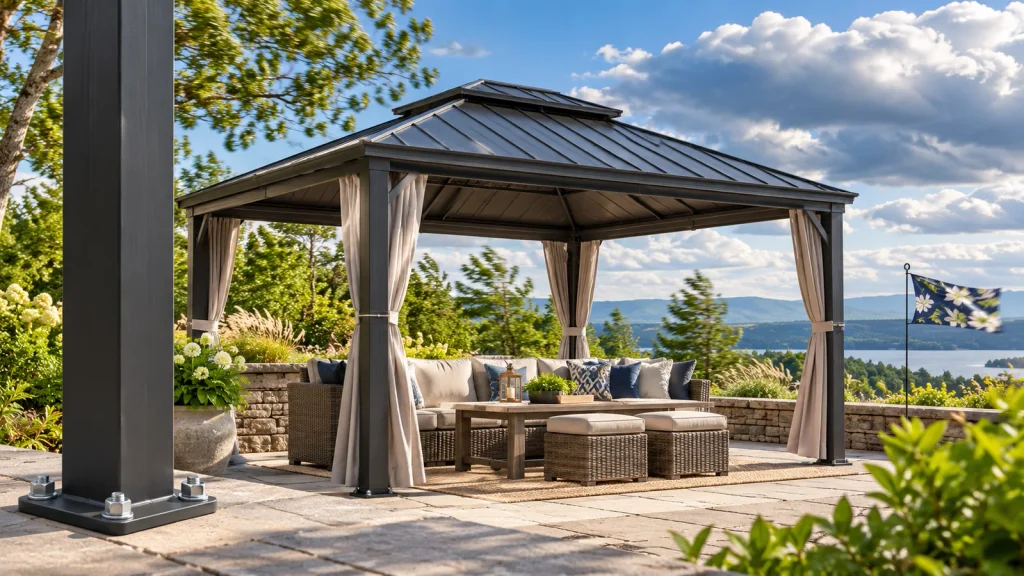
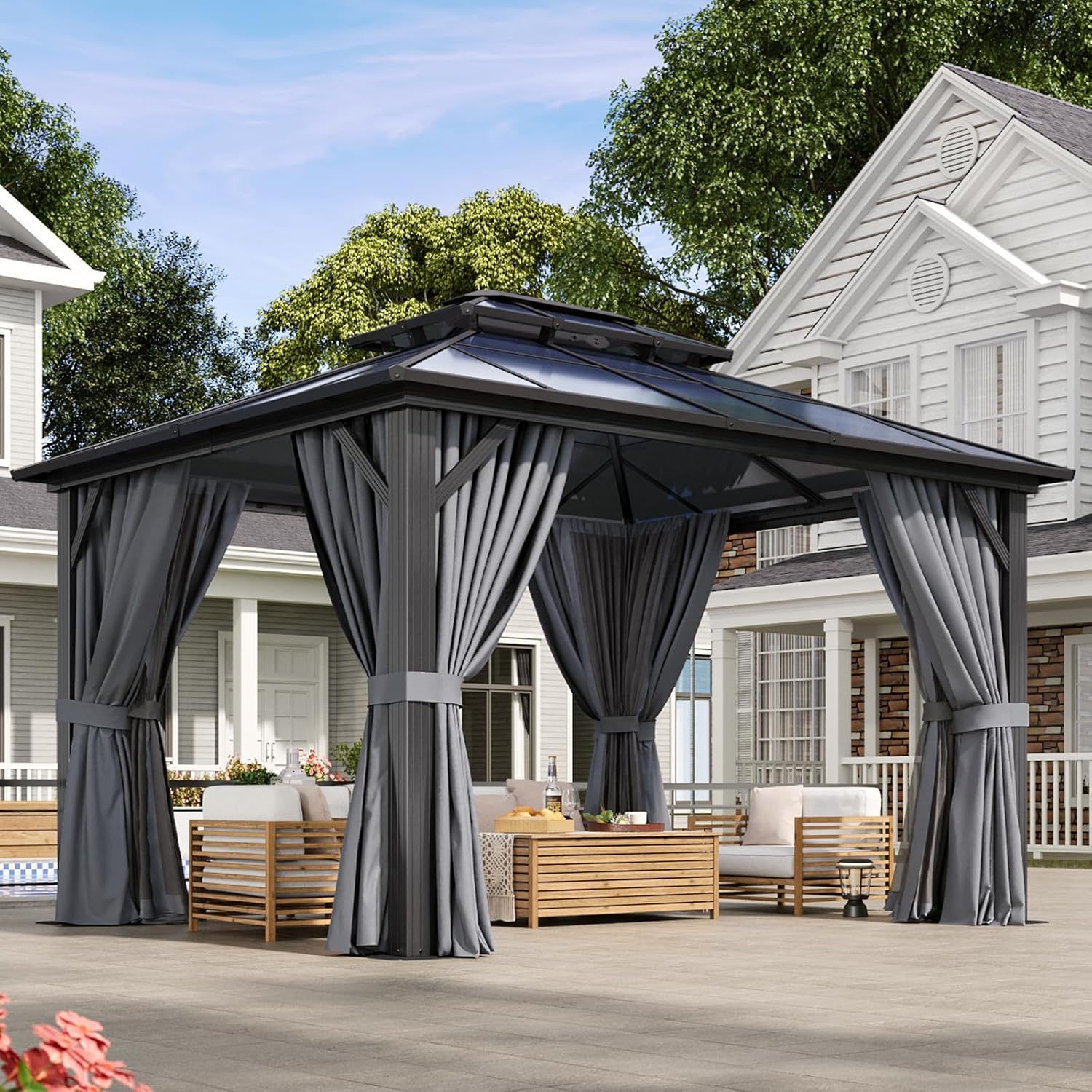
Steeper, sloped metal roofs shed snow more readily than flat or shallow roofs. Snow support poles, sold with some larger models (PURPLE LEAF sells a 12×24 with “2 Snow Support Poles”), add mid-span support. Polycarbonate panels can flex under weight, so check the listing’s panel thickness and support spacing.
Compare snow-focused picks in Best Hardtop Gazebos for Snow and Best Hardtop Gazebos for Year-Round Use.
Who should be cautious
If your area gets heavy, wet snow or frequent winter storms, and you cannot clear the roof promptly, choose a model with a strong, clearly stated per-area rating, or plan to remove panels for winter. Soft top and pop-up gazebos are not suitable for snow at all.
How we put this guide together
Snow claims were extracted from listings in our catalog of 724 gazebo and canopy products (September 2026). Conversions are our own arithmetic using the stated title dimensions as roof area. Quotes are copied from the named manufacturer listings. This is not structural advice; for a permanent structure in heavy-snow country, consult your local building department.





Write Your Review
No reviews yet. Be the first to share your experience!