

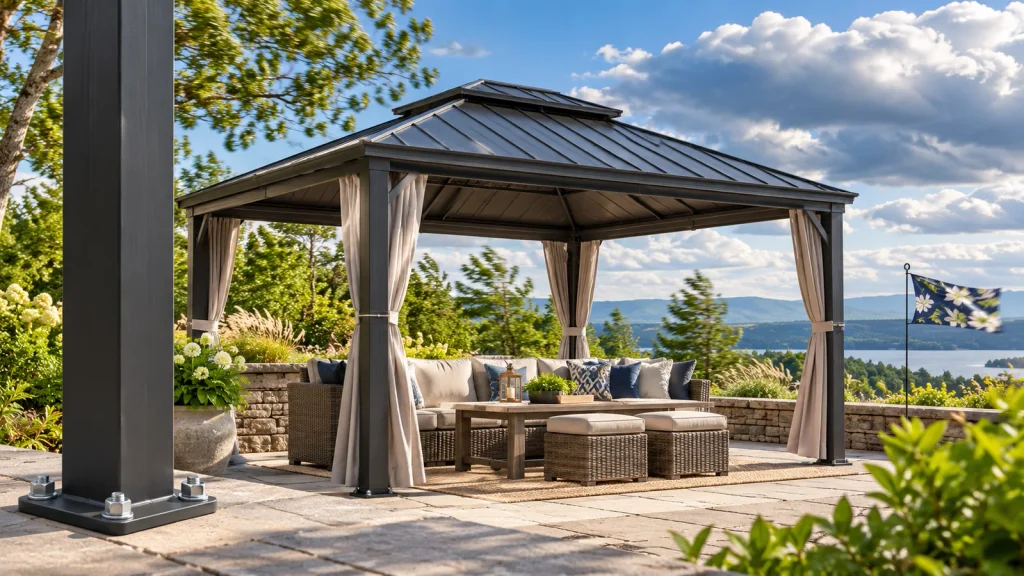
Gazebo listings love wind numbers: 38 mph, 60 mph, “Level 12 (73-83 mph).” These figures are useful for comparing products, but only once you know what scale they use and what conditions come attached. This guide decodes them with real examples from our catalog of 724 gazebo and canopy listings (September 2026).
The short version
- Wind ratings on gazebo listings are manufacturer claims. None of the listings we reviewed name an independent rating standard.
- Nearly all hardtop ratings apply only after the gazebo is anchored, and usually with curtains retracted.
- Many listings use a numbered “grade” or “level” scale; the mph range tells you which scale they mean.
- Pop-up ratings are much lower than hardtop ratings, often 12 to 25 mph.
What the numbers look like across the catalog
About 135 hardtop listings in our catalog state a wind speed. The most common figures were 38 to 40 mph, 60 mph, and 83 mph (the top of a “73-83 mph” range). About 35 pop-up listings state a figure, mostly between 12 and 25 mph.
| Type | Most common claims | Example wording |
|---|---|---|
| Hardtop | 31 to 38 or 40 mph | “wind resistance up to 40 mph” (PURPLE LEAF 10×10) |
| Hardtop | 60 mph | “withstand wind speeds up to 60 MPH” when properly anchored (Kozyard) |
| Hardtop, wood frame | 73 to 83 mph | “12(73-83mph) wind resistance after installing expansion bolts” (Aoxun) |
| Pop-up | 12 to 25 mph | “Can withstand winds up to 12 mph” (COBIZI 12×12) |
Decoding “grade 7” and “level 12”
Many listings express wind as a numbered level. These refer to wind-force scales descended from the Beaufort scale, which the US National Weather Service publishes. On the Beaufort scale:
| Force | Name | Wind speed |
|---|---|---|
| 6 | Strong breeze | 25 to 31 mph |
| 7 | Near gale | 32 to 38 mph |
| 8 | Gale | 39 to 46 mph |
| 9 | Strong gale | 47 to 54 mph |
| 10 | Storm | 55 to 63 mph |
| 11 | Violent storm | 64 to 72 mph |
| 12 | Hurricane force | 64 knots (about 74 mph) and above |
So when Aoxun writes “wind resistant grade of the gazebo is 7 (31-38mph),” that is near-gale force. When another Aoxun listing says “Level 9 winds (47-55 mph),” that is a strong gale.
“Level 12 (73-83 mph)” needs more care. On the standard Beaufort scale, force 12 is hurricane force and has no upper limit. The bounded 73 to 83 mph range matches an extended scale used in some countries that continues past 12 to higher levels. Either way, a “Level 12” claim describes hurricane-force wind. We would not rely on any backyard gazebo in those conditions, and neither should you. It is a figure for comparing frames, not a promise that the structure will survive a hurricane.
The conditions attached to every claim
Read the full sentence around the number. Common conditions include:
- Anchoring: “after installing expansion bolts” (Aoxun), “When properly anchored” (Kozyard), “Secured with included anchors” (a lean-to pergola rated to 38 mph).
- Curtains retracted: “Retract the curtains and netting during strong winds and avoid use in extreme weather” (HOTEEL, Tooluck).
- Use limits for pop-ups: “DO NOT recommend using when the wind force reaches level6 (+24 Mph)” (East Oak).
Also notice that a figure like “up to 40 mph” does not say whether it means sustained wind or gusts. Gusts are routinely higher than the sustained speed in a forecast, so compare the rating to your local gusts, not the average.
How to use wind ratings sensibly
- Check the gust speeds your area actually sees in storms, using local weather records or forecasts.
- Shortlist gazebos whose stated rating is well above that, not just equal to it.
- Confirm you can anchor it the way the rating requires on your surface. See How to Anchor a Hardtop Gazebo.
- Plan to open curtains and remove any fabric panels before storms.
- For pop-ups, plan to take them down, whatever the rating. See How to Secure a Pop-Up Gazebo.
Design features that help in wind
- A properly anchored frame with wide posts and bracing at the corners.
- A double-tier or vented roof that lets air escape rather than lifting the roof.
- Solid metal roofs over fabric; fabric tops can tear and flap.
- Fewer enclosed walls; curtains and sidewalls add sail area.
Compare models chosen with wind in mind: Best Hardtop Gazebos for High Winds, Best Wind Resistant Soft Top Gazebos, and Best Pop-Up Gazebos for Wind.
Who should not rely on a gazebo in wind
If your property regularly sees strong gales, sits on an exposed hilltop or shoreline, or is in a hurricane-prone area, treat any gazebo as a structure to prepare and possibly disassemble before major storms, and consider getting local professional advice on anchoring.
How we put this guide together
Wind figures were extracted from the titles and descriptions of listings in our catalog of 724 gazebo and canopy products (September 2026); some listings state more than one figure. Beaufort ranges follow the scale published by the US National Weather Service, rounded to whole mph. Quotes are copied from the named manufacturer listings.


Write Your Review
No reviews yet. Be the first to share your experience!