

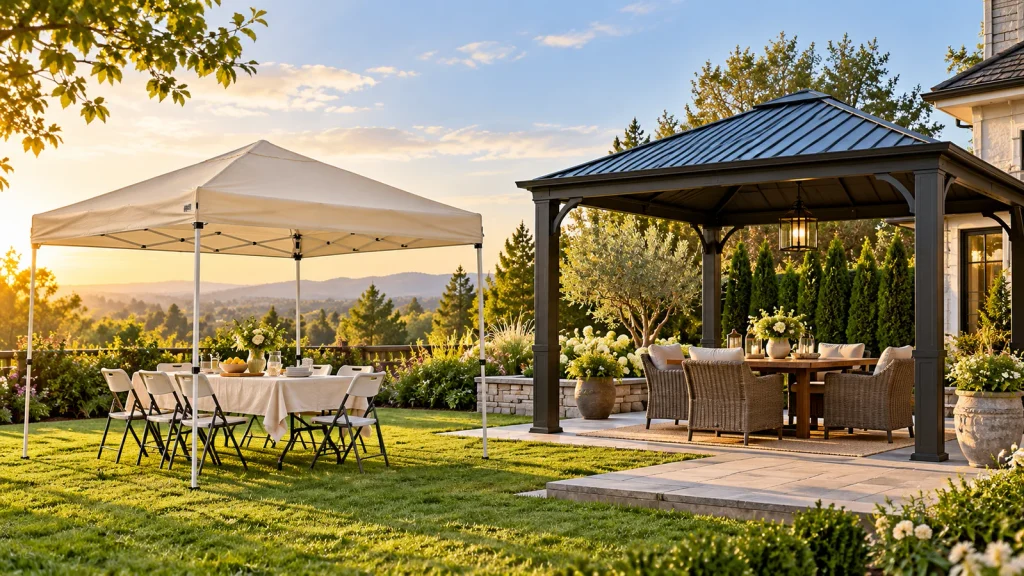
A pop-up canopy and a permanent gazebo can look alike in product photos, and both are sold as “gazebos” on Amazon. In practice they solve different problems. A pop-up is portable shade you set up for a few hours; a permanent gazebo is a structure you install once and live with. Here is how to tell which you need.
At a glance
| Factor | Pop-up canopy | Permanent gazebo (hardtop or soft top) |
|---|---|---|
| Setup | Minutes, often by one or two people | Hours, with a team, then left in place |
| Anchoring | Stakes, ropes, weight bags | Bolts, footings, or ground anchors |
| Typical wind claims | 12 to 25 mph | Hardtops commonly 38 to 60 mph, anchored |
| Rain | Light rain; water can pool | Designed for rain, many with gutters |
| Snow | No | Hardtops only, with clearing |
| Storage | Folds into a carry bag | Stays up; soft top canopy stored in winter |
| Common sizes | 10×10 and 12×12 | 10×12 most common for hardtops |
Setup and portability
This is the pop-up’s whole reason to exist. Many listings describe one-person setup; EVER ADVANCED, for example, advertises “1 Min Pop up No Initial Assembly Required,” and CROWN SHADES promotes “one-person quick setup and easy take down.” That makes pop-ups right for tailgates, markets, sports sidelines, camping, and parties. A permanent gazebo, by contrast, typically takes 2 to 4 adults several hours to assemble according to manufacturer estimates, and is then fixed in place.
Wind: the deciding difference
Pop-up listings in our catalog (September 2026) state far lower wind limits than permanent gazebos. COBIZI’s 12×12 says it “Can withstand winds up to 12 mph”; East Oak advises against use once wind “reaches level6 (+24 Mph).” Hardtop listings commonly claim 38 to 60 mph when anchored. If the shelter must stay up unattended, overnight, or through summer storms, a pop-up is the wrong tool. See How to Secure a Pop-Up Gazebo and Gazebo Wind Ratings Explained.
Weather beyond wind
Pop-up tops are fabric stretched over a folding frame. Rain can pool on a flat canopy and bend the frame, and pop-ups are not intended for snow. Permanent hardtops shed rain through gutters and many list a snow capacity (with clearing). Soft top gazebos sit in between: permanent frames, seasonal fabric.
Lifespan and cost
Pop-ups cost less upfront and fold away, but fabric tops and folding joints wear with repeated use, and one gust at the wrong moment can bend a frame. Permanent gazebos cost more and require anchoring, but a hardtop’s roof is not a wear part. The right comparison is cost per season of use, not purchase price.
Where each one fits
| Use | Better fit |
|---|---|
| Farmers market or craft fair booth | Pop-up (vendor picks) |
| Camping and tailgating | Pop-up (camping picks) |
| Occasional backyard party | Pop-up (party picks) |
| Everyday outdoor dining area | Permanent gazebo (dining picks) |
| Covered grill or outdoor kitchen | Permanent hardtop (outdoor kitchen picks) |
| Hot tub or pool shade all season | Permanent hardtop (pool area picks) |
Who should skip a pop-up
- Anyone who wants to leave the shelter up for days or weeks.
- Yards with regular afternoon wind or frequent thunderstorms.
- Anyone planning to cook under it; a folding fabric canopy is a poor match for grill heat.
Who should skip a permanent gazebo
- Renters, or anyone who cannot anchor into concrete, a deck frame, or footings.
- People who mainly need shade away from home.
- Anyone whose HOA or town does not allow a permanent structure in that spot.
Next steps
Compare pop-ups in Best Pop-Up Gazebos. If a permanent structure fits better, decide on the roof type with Hardtop vs Soft Top Gazebo, then use How to Choose a Gazebo to narrow the list.
How we put this guide together
Wind figures, sizes, and quotes come from the 724 gazebo and canopy listings in our catalog (September 2026). All figures are manufacturer claims, copied from the named listings, and have not been verified by us.


Write Your Review
No reviews yet. Be the first to share your experience!